What is closed, and what is not
The closure came in stages. Levels two to five — the modern art galleries and the public library — shut in March 2025 and the collection was taken down. The building closed to the public on 22 September 2025, the last exhibition ending that evening with free admission until eleven at night, followed by a farewell weekend on the piazza in October. The remaining spaces went dark that December, and the works themselves began in 2026.
Closed: the museum, the exterior escalator, the roof terrace, the sixth-floor restaurant and the main shop.
Still open, and worth knowing about:
- The public library has moved, not closed. The Bibliothèque publique d'information reopened in August 2025 in the Immeuble Lumière in the twelfth arrondissement, with the same hours and the same free access. It is a reference library — nothing is lent — and it remains one of the most useful free rooms in Paris.
- The cinema programme has moved to a multiplex beside the national library at François-Mitterrand, and the teenage programme to the Gaîté Lyrique.
- IRCAM is entirely unaffected. The music and acoustics institute founded by Pierre Boulez occupies its own building next door, on the place Igor-Stravinsky, and its programme continues.
- The piazza remains a public square, with occasional events, though the sloping forecourt immediately against the building is a construction site and access to it should not be assumed.
- A free welcome and resource space has opened in the former Brancusi pavilion on the piazza, closed on Tuesdays.
Where the collection is in the meantime
Rather than putting the collection into storage, the Centre has dispersed it. The programme runs under the name Constellation until 2030, and it means there is no single place in Paris where "the Pompidou collection" can be seen — it travels exhibition by exhibition.
In Paris the regular partners are the Grand Palais, which takes the largest shows, the Panthéon, the Musée d'Art Moderne de Paris and the Bibliothèque nationale at Richelieu. Outside Paris, Centre Pompidou-Metz continues as normal, and there are showings at Lyon, Toulon, Lille, Aix-en-Provence and elsewhere, together with a mobile exhibition in a lorry. Anyone wanting to see a particular artist should check what is on where, rather than going to any one building.
A permanent addition is also coming out of the closure. Centre Pompidou Francilien, at Massy south of Paris, will hold the reserves and mount exhibitions, and is due to open in spring 2027.
The building, and who made it
Older accounts describe the architects' intention to turn the building inside out without naming a single one of them. They were Renzo Piano, Richard Rogers and Gianfranco Franchini, who won an open competition in 1971 against six hundred and eighty-one other entries — and the engineering, which is at least half of what makes the thing stand up and look as it does, was by Arup, with Peter Rice as lead engineer. Rogers died in 2021 and Rice in 1992; Piano is still working.
It opened on 31 January 1977. Georges Pompidou, who commissioned it as President of France in 1969, died in office in April 1974 and never saw it finished — a fact older accounts leave out while calling the place a faithful reflection of its century.
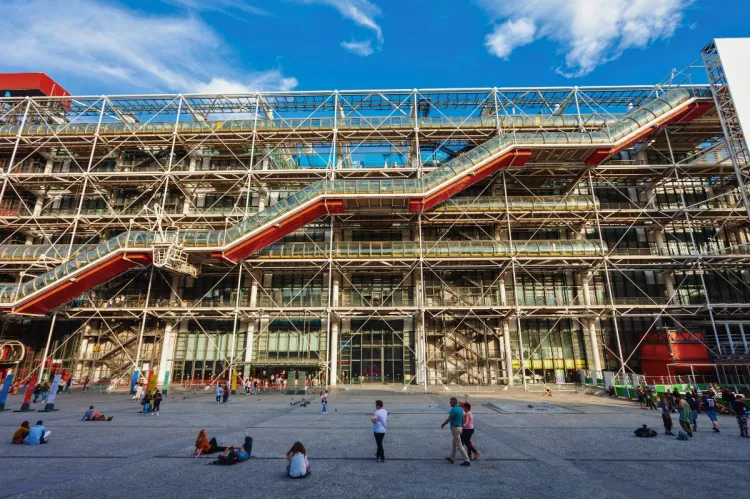
Describing it as the modern heir to the Bauhaus, as older accounts do, gets it backwards. The Bauhaus hid its services; this building was conceived as a deliberate reaction against that, putting structure, ducts and circulation on the outside precisely so that the floors inside could be left as uninterrupted open space. That is the argument, and it is why the plans are so flexible — and also why the exterior has now worn out and has to be replaced wholesale.
The colours, and what they mean
The exterior colour code is real and is worth reading rather than merely photographing:
- Blue — air handling and climate control.
- Green — water and plumbing.
- Yellow — electricity.
- Red — circulation and safety: the lifts and escalators, and the fire equipment. Older accounts give red as the escalators alone, which is half of it.
The façades are being wholly replaced in the current works, and the colour coding is to be kept — but for the next few years the exterior is behind hoardings and cannot be seen as intended.
What is inside it, properly named
Older accounts list four activities without naming any of them, and one of the four no longer exists.
- The Musée national d'art moderne, which holds close to a hundred and fifty thousand works — the largest collection of modern and contemporary art in Europe, and one of the two largest anywhere. Older accounts give fifty-six thousand, which was true a long time ago.
- The Bibliothèque publique d'information, the free public reference library described above. It should not be confused with the Centre's own research library, the Bibliothèque Kandinsky, which is a separate thing and is moving to the Brancusi pavilion.
- The Centre de création industrielle, the design centre — which ceased to exist as a separate body in 1992, absorbed into the museum. It is not something a visitor can go to.
- IRCAM, for music and acoustic research, which as noted is administratively independent and in its own building.
One correction on a specific work, since older accounts single it out. Warhol's Ten Lizes of 1963 is a single large canvas carrying ten silkscreened repetitions of the same publicity photograph of Elizabeth Taylor, in two rows of five. It is not, as older accounts have it, five small paintings arranged above another five.
On the building's cost, older accounts give a figure in dollars. It was built in francs, in the 1970s, and any dollar conversion is a retrospective guess at an exchange rate; the floor area is about a hundred and three thousand square metres. The current works will cost the better part of half a billion euros, around three-fifths of it from the state.
The square, the fountain, and the other Pompidous
Immediately beside the Centre, on the place Igor-Stravinsky, is the Stravinsky Fountain of 1983 — sixteen sculptures by Jean Tinguely and Niki de Saint Phalle, mechanical and brightly coloured respectively. It is outdoors, it is free, and it is unaffected by the closure. For anyone in the quarter over the next few years it is the one thing here that can still be seen on the spot.
Parisians call the Centre Beaubourg, after the quarter and the plateau it stands on, and the institution uses the name itself. It is a useful habit, because there are now several Pompidous: Metz since 2010, in a building by Shigeru Ban and Jean de Gastines, and partner venues in Málaga, Shanghai, Brussels and Seoul. A planned site in New Jersey was cancelled in 2026.
Finally, the practicalities, for 2030 and for anyone visiting the piazza before then: the nearest station is Rambuteau on line 11, with Hôtel de Ville on lines 1 and 11 a little further, and Châtelet–Les Halles for the suburban lines.