In the UK these lenses can only be supplied through a registered optician, whatever the seller says. What the law requires, why it exists, and what to do if an eye turns painful.
The short answer
No — not legally, and not safely.
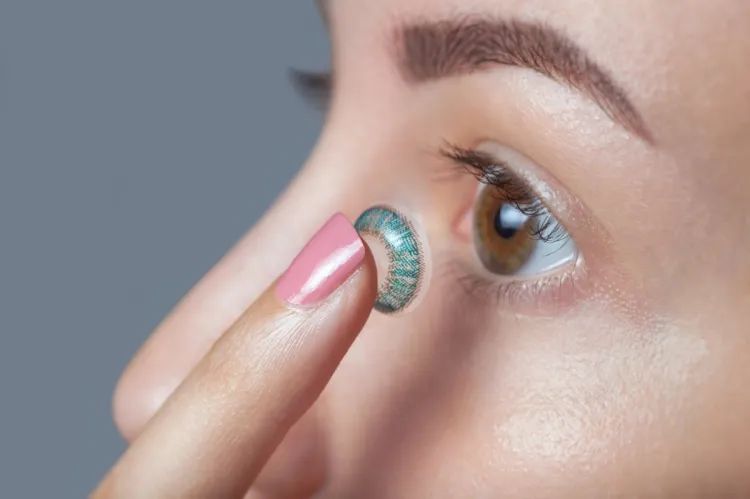
In the UK, coloured and novelty contact lenses sit under the same law as every other contact lens, whether or not they correct vision. They can be supplied only by a registered optometrist, dispensing optician or medical practitioner, or under the direct supervision of one. A fancy-dress shop, a market stall, a beauty counter or an online seller with no registered professional behind it cannot sell them lawfully, no matter how the product is described.
The phrase “no prescription needed” is a reliable sign that a seller is operating outside the law.
What the law actually says
The relevant provision is section 27 of the Opticians Act 1989, which was amended specifically to close the gap that once let zero-powered lenses be sold as cosmetics.
Section 27(1)(b) covers “any optical appliance or zero powered contact lens” — the wording is explicit, so a lens with no corrective power is caught just as a prescription lens is. The sale must be made by, or under the supervision of, a registered medical practitioner, a registered optometrist or a registered dispensing optician.
Contravening that is a criminal offence. Under section 27(10) a person who breaches section 27(1) is liable on summary conviction to a fine of up to level 5 on the standard scale. The General Optical Council can and does act against illegal supply, and the Association of Optometrists runs a long-standing campaign encouraging practitioners to report retailers who continue to stock them.
None of that liability falls on the buyer. The offence belongs to the seller. The consequences of a badly fitted lens, however, fall entirely on the person wearing it.
Why it is regulated
A contact lens is not a one-size-fits-all object. It sits directly on the cornea, and corneas differ in curvature and diameter from one person to the next. A lens that does not match the eye it is on rubs, starves the cornea of oxygen, or traps debris beneath it.
The injuries follow a predictable sequence.
Corneal abrasion. A poorly fitted lens scratches the surface of the cornea. It presents as soreness, redness, watering, sensitivity to light and the persistent sensation of something caught in the eye.
Corneal ulcer. An abrasion that becomes infected progresses to an ulcer. Ulcers are treatable, usually with intensive drops, but they heal by scarring — and a scar across the visual axis permanently degrades sight. Severe cases end in corneal transplant.
Microbial keratitis. Any break in the corneal surface opens it to bacteria, fungi and amoebae. Research has put the increased risk of keratitis among wearers of decorative lenses at roughly sixteenfold compared with non-wearers. Some of the organisms involved are stubborn: herpes simplex recurs, and antibiotic resistance has made several bacterial infections harder to clear than they once were.
Pigment and chemical exposure. The dyes that give these lenses their colour are not always applied to the standards required of a medical device. Pigment sitting proud of the lens surface abrades the eye mechanically, and substances used in unregulated manufacture have been found to leach into the eye.
Long-running damage from any of these raises the later risk of cataract and secondary glaucoma.
The practical point is that the fitting is not an administrative hurdle placed between the customer and the product. The fitting is the thing that prevents all of the above.
Getting them legally
Coloured lenses are entirely available through legitimate channels, and plenty of people wear them without incident. The route is the same as for any other lens.
An optician measures the curvature and diameter of the cornea, assesses tear film and eye health, fits a trial lens, checks how it sits and moves, and teaches insertion, removal and cleaning. The result is a specification — the equivalent of a prescription for a lens that corrects nothing — plus arranged aftercare. Appointments can be made at most high street opticians, and the process takes rather less time than most people expect.
Online purchase is lawful where the seller operates under registered supervision and holds a valid specification for the buyer. That is the distinction worth checking: not whether a website asks for a prescription number, but whether there is a registered professional behind the business at all. Registration can be verified on the General Optical Council’s public register.
Two details from older advice are worth contradicting directly. Novelty lenses sold as “45 day” or “180 day” wear are a particularly poor idea: extended wear sharply increases infection risk even in properly fitted medical lenses, and sleeping in lenses raises it further still. And lenses are never shared, however briefly — sharing transfers whatever is growing on one cornea to another.
When something goes wrong
The signs that matter are pain, redness that worsens rather than settles, sensitivity to light, blurred vision, and discharge.
Any of these means the lens comes out immediately and stays out. An eye that is still painful or red after the lens is removed needs to be seen the same day — by an optometrist, an urgent eye care service, or an accident and emergency department. The lens itself is worth keeping in its case for the clinician to look at.
What should not happen is waiting to see whether it settles overnight. Corneal infections move quickly, and the difference between a complete recovery and a permanent scar is often measured in hours rather than days.
Tap water should never touch lenses or lens cases, which is the route by which acanthamoeba — rare, extremely painful and very difficult to treat — reaches the eye.
The seasonal problem
Demand for these lenses concentrates around Halloween and fancy-dress events, and so do the injuries. Eye casualty departments see the pattern every year.
The timing works against safety in two ways. The purchase is usually made close to the event, when there is no time to arrange a fitting, and the lenses are bought alongside a costume rather than from anyone qualified to supply them. A seller who offers them in late October without asking a single question about the buyer’s eyes is, by definition, not operating lawfully.
Anyone wanting coloured lenses for a specific date is better served by arranging the fitting several weeks ahead, which also allows time to discover whether lenses suit them at all. For anything closer to the night itself, there are plenty of costume ideas that need no lenses at all.
Changed