The King does not live here. Since June 2026 it has been settled that Charles III will keep Clarence House as his London home for the rest of his reign, while Buckingham Palace stays what the Keeper of the Privy Purse called "Monarchy HQ" — offices, banquets, investitures, and the Standard flown from the roof whenever the King is in London. It is still the sovereign's official residence, as it has been since 1837. It is simply no longer anybody's house, and the point of that is to let more of the public in.
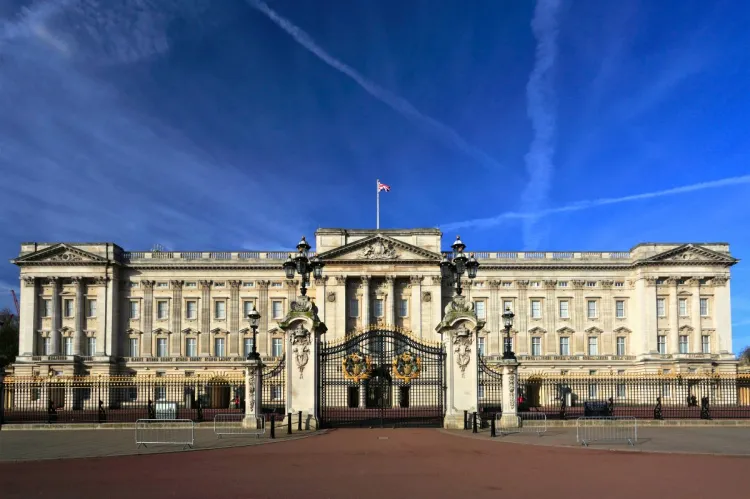
A house, then four wings round a courtyard
The nucleus is Buckingham House, built in 1703 — some accounts give 1705 — for John Sheffield, Duke of Buckingham, to a design by William Winde. George III bought it in 1761 for about twenty-one thousand pounds, as a private retreat for Queen Charlotte. Older accounts give 1762; the official sources give 1761.
Almost nothing a visitor sees is that house. John Nash encased and rebuilt it from 1825 for George IV, producing three ranges around a courtyard open to the east, and Edward Blore finished the work. Then came the change that gives the palace its present shape: Blore's east wing, built by Thomas Cubitt between 1847 and 1850, closed the quadrangle — paid for in part by selling the Brighton Pavilion. James Pennethorne added the ballroom block in 1853–54.
So it is a building of four ranges around a quadrangle, and that fourth range is why the Marble Arch had to move. Older accounts describe three wings and then mention the arch in an unexplained aside; the two facts are the same fact.
Victoria made it the official London residence of the sovereign in 1837, moving in that July as the first monarch to live there. It has 775 rooms, of which nineteen are the State Rooms, with 52 royal and guest bedrooms, 188 staff bedrooms, 92 offices and 78 bathrooms; the front is a hundred and eight metres across.
The Marble Arch, properly
John Nash designed it in 1827 as the state entrance to the palace's forecourt, standing roughly where the central balcony is now. Work stopped when George IV died in 1830 and Blore completed it in 1833. When the east wing needed the site, the arch was dismantled in 1847 and re-erected by Cubitt at Cumberland Gate, finishing in March 1851.
Two corrections to the usual account. The move took four years, so a single date of 1851 is the end of it rather than the whole. And the arch is no longer in Hyde Park at all: the Park Lane works of 1960 to 1962 left it on a traffic island outside the park, and it is maintained by Westminster City Council rather than the Royal Parks. Speakers' Corner — not Speaker's — is on the park's north-east edge nearby, so proximity is right and location is not.
The 1913 front, and why it is not the last word
Aston Webb refaced the east front in Portland stone in 1913 for George V, the building work itself taking thirteen weeks. The forecourt, gates and railings had been completed two years earlier as part of the setting for the Victoria Memorial, which is Sir Thomas Brock's and was unveiled on 16 May 1911.
Older accounts call 1913 the palace's last major change. That is true only of the principal façade. Since then the building has been bombed, had a destroyed chapel converted into a public gallery, and been taken apart internally by the largest intervention since Webb.
The war, and the origin of the summer opening
On 13 September 1940 six bombs fell on the palace while the King and Queen were inside — two in the forecourt, two in the quadrangle, one on the chapel and one in the garden. It was hit nine times during the war. The chapel was not rebuilt as a chapel: its site became the gallery that opened in 1962.
The summer opening, which older accounts describe without explaining, has a specific cause. The Windsor Castle fire of 20 November 1992 gutted about a hundred rooms. The buildings were uninsured, restoration was put at some forty million pounds, and the State Rooms were opened to paying visitors for the first time on 7 August 1993, at eight pounds a head, with the proceeds going to Windsor.
The King's Gallery, which is no longer the Queen's
Older accounts still call it the Queen's Gallery. The renaming was announced on 4 December 2023 and took effect through 2024, with the signage changed that spring; the Edinburgh gallery at Holyroodhouse was renamed at the same time. It is The King's Gallery, and it stands on the site of the bombed chapel.
The Royal Mews keeps its name and marked its bicentenary in 2025, the building dating from 1825. The coach in it is the Gold State Coach — not the Golden State Coach, a name no source uses. It was commissioned in 1760 and finished in 1762, designed by Sir William Chambers with painted panels by Cipriani and carving by Joseph Wilton, and it was last used at the coronation of Charles III in 2023.
What is in the State Rooms
Older accounts promise Rubens, Vermeer and Canaletto, and all three are there, in the Picture Gallery, which is on the public route. One correction worth making: the Royal Collection holds a single Vermeer, the Lady at the Virginals with a Gentleman, so the plural would be wrong.
The gallery was rehung for the 2026 summer opening and now shows a hundred and twenty paintings, against sixty-three before: seven Rubens, five Rembrandts, twelve Canaletto views of Venice, and work by Titian, Caravaggio, Van Dyck, Hals, Gainsborough and Stubbs. Worth knowing that these pictures move — during the roof replacement around 2019 to 2021 they were shown in the gallery on Buckingham Palace Road instead.
The East Wing, open for the first time
This is the development older accounts cannot contain, and it is recent. In July 2024 the East Wing opened to visitors for the first time since it was finished a hundred and seventy-five years earlier: the Centre Room, which is the room behind the famous balcony, the Yellow Drawing Room, and the Principal Corridor, some two hundred and forty feet of it.
From 2025 the East Wing tours were extended into the first months of the year, and they come with a detail that had never been offered before: visitors enter through the palace's front gates and cross the forecourt, the way guests arrive for official events.
The balcony itself has been used for public appearances since 1851 — Trooping the Colour, royal weddings, jubilees, and VE Day on 8 May 1945.
The reservicing, with the dates it actually has
Older accounts say only that improvements have been made "in recent years" as part of a ten-year project, which tells a reader nothing. The particulars:
- A £369 million programme replacing wiring, plumbing and heating, funded by a temporary increase in the Sovereign Grant.
- It began in April 2017 and is due to complete by the end of March 2027. 2026–27 is the final year, carrying what the accounts call the last tranche of funding.
- The programme as a whole has stayed within budget, but the National Audit Office reported in July 2024 that the East Wing finished more than two years late and 78 per cent over its own cost estimate, that the timeline and delivery strategy had been reset three times, and that far more asbestos was found than expected.
The garden, with the right numbers
Older accounts give forty acres and more than three hundred and fifty types of wildflower. The Royal Collection's own figures are 39 acres — still the largest private garden in London — and 325 species of wild plant, which is not the same category as wildflowers. There are over a thousand trees and some thirty species of breeding bird. The lake was excavated by about 1828, and the garden has been a Grade II* registered park and garden since 1987, with the Grade I Waterloo Vase in it. The palace itself has been Grade I listed since 1970.
One item in older accounts should go: a helicopter landing area appears in no official description of the garden. Helicopters do land on the lawn, but there is no documented helipad, and it is not a feature of the place.
Guard Mounting
Older accounts have the essentials right. It is more formally Guard Mounting, and Household Troops have guarded the sovereign since 1660. The guard at Buckingham Palace changes on Monday, Wednesday and Friday, daily in early summer, and the ceremony runs about forty-five minutes. Regiments from across the Commonwealth take their turn, as do units of the Royal Navy and the Royal Air Force.
Two things to put differently. The ceremony is sometimes altered or cancelled at short notice, particularly in wet weather, with the decision taken on the morning — which is not the same as the confident schedule older accounts imply. And the claim that four sentries stand when the King is in residence and two when he is away is not supported by the Household Division or the Royal Household, so it is better left out than stated; the sentries stand on the forecourt, inside the railings, rather than at the front of the building.
Who actually comes here
Older accounts say the palace hosts over fifty thousand guests a year "including dignitaries and the general public". The figure is the Royal Household's own, and it counts invited guests at official entertaining only — state banquets, lunches, dinners, receptions and garden parties. The public are a separate and much larger number, around seven hundred thousand paying visitors a year. Conflating the two makes the palace sound less visited than it is by an order of magnitude.
The nearest stations are Green Park, Victoria and St James's Park.
Changed