Brushes
Most brushes sold for household painting have synthetic filaments, which keep their shape in water-based paint and leave fewer marks in it. Natural bristle is the traditional choice for solvent-based gloss and varnish; it goes limp in water-based paint.
Widths are still commonly given in inches as well as millimetres. Three cover most work:
- 25 mm (1 inch) for window bars and narrow mouldings
- 50 mm (2 inch) for cutting in, door frames and skirting boards
- 100 mm (4 inch) for large flat areas where a roller is not used
A brush with the filaments cut at an angle makes a straight line against an edge easier to hold. Poorly made brushes shed filaments into the paint, and the difference is visible on the wall.
Rollers
The standard roller is 230 mm (9 inches) wide. What matters is the sleeve, and above all the length of its pile:
- Short pile for smooth plaster and for silk and soft sheen emulsion
- Medium pile for matt emulsion on ordinary walls and ceilings
- Long pile for textured surfaces and masonry
Small rollers of about 100 mm, with foam or fine-pile sleeves, are used for gloss and satin on flush doors and for narrow spaces. A long-handled version reaches the wall behind a radiator.
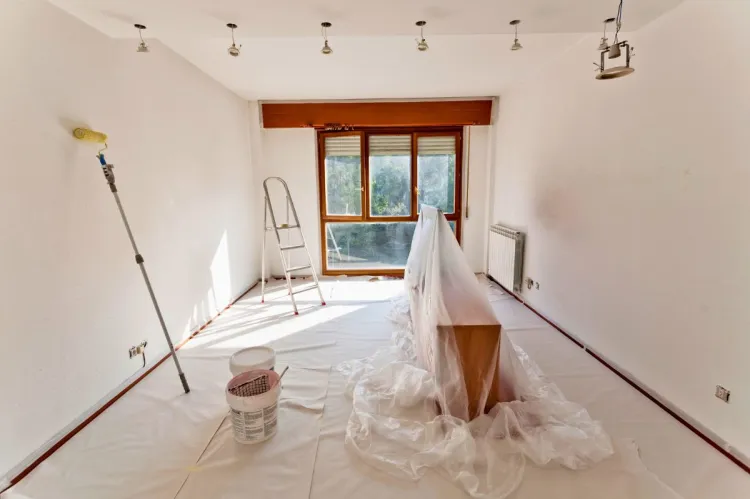
An extension pole screws into the roller handle and allows ceilings and the tops of walls to be painted from the floor.
Trays and kettles
A roller tray holds paint in its well and has a ribbed slope for loading the sleeve evenly. For large areas a roller bucket, or scuttle, holds more and is harder to tip over. A paint kettle — a small pot with a handle — carries the working quantity for brushwork, so that the main tin stays closed and clean.
For preparation
- Dust sheets, preferably cotton
- A scraper for loose paint and a filling knife for filler
- Filler for plaster and decorator's caulk for gaps
- Abrasive paper in medium and fine grades, with a sanding block
- Sugar soap, a sponge and a bucket
- Masking tape of the right grade for the surface
- A dust mask rated FFP2 or FFP3 for sanding, and eye protection for ceilings
Ladders and stepladders
The standard for portable steps and ladders is EN 131, and the label on a ladder shows the load it is made to carry.
The Health and Safety Executive's guidance on ladders is written for workplaces and applies equally well at home:
- A stepladder is used with its locking devices engaged, all four feet on the ground and the steps level.
- The top three steps of a stepladder are not stood on unless there is a suitable handhold.
- Three points of contact are kept at the working position.
- Nobody overreaches: the body stays between the sides of the ladder, and the ladder is moved instead.
- A leaning ladder is set at an angle of about 75 degrees — one unit out for every four up — and tied or otherwise secured.
- A job that would mean more than half an hour at a time on a ladder calls for other equipment.
For ceilings, a roller on an extension pole avoids the stepladder altogether. For stairwells and the upper storeys of a house, a platform or a tower scaffold is the safer equipment, and can be hired.
Looking after equipment
Brushes and sleeves last for years if they are cleaned at once after use — in water for water-based paint, in white spirit or brush cleaner for solvent-based — and dried before being put away. Brushes are hung or laid flat, never stood on their filaments.