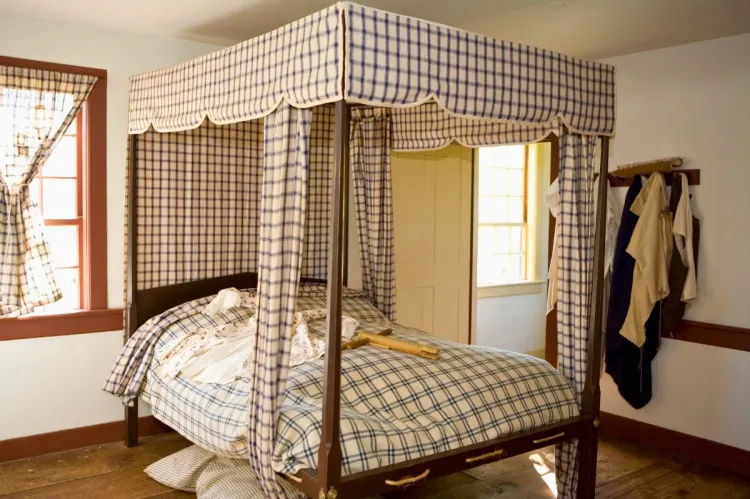
The bed
Beds are sold in two forms. A divan is an upholstered box base on castors or short legs, usually with drawers, and a separate headboard. A bedstead is a frame of wood or metal with slats, standing clear of the floor.
- Size follows the mattress. British sizes differ from European ones, as set out under choosing a mattress, and a frame made abroad may need a mattress to match.
- Slats are either sprung — curved, and giving slightly — or solid. Gaps wider than about seven centimetres let a mattress sag between them, and many mattress guarantees say so.
- Storage. Divan drawers need room at the side to open. An ottoman base, where the whole top lifts on gas struts, needs none, and suits a narrow room.
- Height. A bed whose top is about level with the back of the knee is the easiest to get in and out of.
Wardrobes
Clothes on hangers need a clear depth of about 60 centimetres, which is why wardrobes shallower than that hang clothes facing forward on a pull-out rail. A hinged door needs its own width of clear floor in front; a sliding door needs none but shows only half the interior at a time.
Fitted wardrobes are built into an alcove or along a wall and use the full height of the room and any awkward corner. They cannot be taken to the next house. Freestanding wardrobes can, and most now arrive flat-packed, which also settles the question of whether they will go up the stairs.
Drawers
A chest of drawers is judged by its drawers. Sides joined to the front with dovetails, a base set into a groove, and runners that let the drawer pull out fully without tipping are the signs of one made to last. Drawers that are stapled, with a thin base pinned underneath, do not survive being overfilled.
Fixing furniture to the wall
A chest of drawers or a wardrobe can topple forward when a child pulls out the drawers and climbs them, and children have been killed this way. New furniture is supplied with a strap or bracket for fixing it to the wall. It should be used, with a fixing suited to the wall — a plasterboard wall needs a different one from brick — and heavy things kept in the lowest drawers.
What it is made of
- Solid wood — oak, pine, ash, beech — can be repaired and refinished, and moves slightly with the seasons.
- Veneered board has a thin layer of real wood over a manufactured core. Well made, it is stable and durable; the edges show the quality.
- Melamine-faced chipboard and painted fibreboard make up most flat-packed furniture. They do not tolerate being taken apart and reassembled many times, and swell if they get wet.
Board made for the European market is graded for the formaldehyde it gives off, and E1 is the grade to look for.
Second-hand
Older wardrobes and chests of solid wood are widely available second-hand, often for less than new flat-packed furniture and better made. The checks are for woodworm — small round holes with fresh dust beneath them — for drawers that run, and for dimensions: wardrobes made before fitted cupboards were common are large, and some come apart into sections for the stairs and some do not.
Style
The names attached to bedroom furniture — Shaker, Scandinavian, mid-century, French, industrial — describe proportions and finishes more than periods: plain panelled doors and wooden knobs; pale wood and tapered legs; teak and long low lines; curved legs and painted carving; steel and reclaimed timber. A room is calmer when its pieces share a finish, and smaller rooms are helped by furniture that stands on legs and shows the floor beneath.
Sheets and duvets are covered under bedding materials.