Baby Shower Photography and Video
Everyone at a baby shower has a camera in their pocket, which is exactly why the important moments are so often missed. Someone has to be given the job.
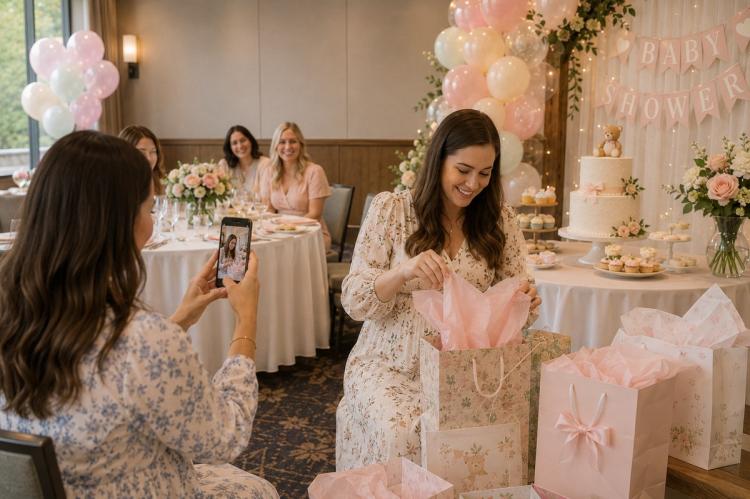
Plenty of photographs get taken at a baby shower. What tends not to happen is anyone capturing the moments that will matter afterwards — the gift being opened, the room full of people, the guest of honour with each of the friends who came.
Guests photograph what happens in front of them when their hands are free. The host is occupied with the food, the door and the running order. The guest of honour is the least able of anyone to take pictures. Left to itself, the afternoon produces forty near-identical shots of the cake and none of the people.
The fix is simple: one person is given photography as their job, and told so in advance.
Hiring a professional
For a larger or more formal shower, a professional produces results nobody else will. Someone with event experience knows to work the room, to catch reactions rather than poses, and to get a decent group photograph without twenty minutes of arranging.
The cost is real, and it competes directly with catering and the venue for the same budget. Good photographers book up well ahead, so anyone going this route should be arranging it six to eight weeks before the shower, in writing, on the terms set out in Hiring professional talent for a baby shower.
Asking someone who is coming anyway
For most showers this is the better answer. A friend or relative with a good eye, asked properly in advance rather than tapped on the shoulder on the day, will do a perfectly good job with a phone.
Asking properly means giving them the brief below, telling them they are excused from helping with anything else, and making sure their phone is charged and has space on it. It is a real job and they should be thanked as such — with a drink, a plate of food and a moment to sit down.
What is worth capturing
- The room, the table and the cake before any guests arrive, while everything is still arranged
- Guests as they arrive, before the room fills
- The guest of honour with each guest, or with each small group — the shots most often wanted afterwards and most often forgotten
- Gift opening, including reactions rather than only the objects
- Any games, and the winners
- One group photograph of everybody, taken early while all the guests are present and nobody has left
- The quiet moments between the scheduled parts, which are usually the best of them
Collecting everyone's photographs
The most useful thing a host can do costs nothing. Create a shared album before the day, and send the link to guests so that everything they take lands in one place. Printing the link as a QR code and leaving it on the tables means guests can add to it as the afternoon goes on, without anyone having to ask them afterwards.
This solves the problem the old disposable-camera trick was meant to solve, and solves it better. Disposable cameras have come back into fashion as a deliberate choice, and the results have a charm that phones do not — but they still have to be collected, and developing a dozen of them costs more than most hosts expect.
A shared album also serves guests who could not attend, including anyone who joined by video call. They see the afternoon without anybody having to send anything to anyone.
Video
Video is a separate job, not an extension of the same one. Someone trying to shoot stills and film at the same time does neither properly, so if video matters it needs its own person — or an accepted decision that the photographs come first.
What works is short clips rather than continuous filming. Nobody watches forty minutes of a party; a dozen clips of ten or twenty seconds get watched repeatedly. Arrivals, the cake, a game in progress, a reaction to a gift, the room at its noisiest.
The one piece of video worth planning properly is a set of recorded messages for the baby. Guests take a minute each, somewhere quiet enough to be heard, and say something to be watched years later — advice, a welcome, a prediction about what the child will be like. It has largely taken over from the written advice cards, and it is the footage families keep. It needs a quiet corner, someone to invite people over one at a time, and a note on the running order so it does not get forgotten in the last half hour.
Live-streaming or a video call for guests who cannot attend is a third distinct job again, and a different one from filming. Someone has to hold the connection, point it at whatever is happening, and remember that the remote guests exist. Where the venue is not the host's home, the internet connection is worth checking in advance.
Before sharing anything publicly
Photographs from a shower now travel further than the guest list. Two courtesies are worth observing.
The guest of honour decides what goes onto public social media. Some parents are happy for pictures of the day to circulate; others prefer the pregnancy, the name or the date to stay within a smaller circle, and they may not have said so unprompted.
Guests should be asked too, particularly where their children appear. A shared album with a link is private in a way a public post is not, and it is the safer default for everything except the handful of pictures people have agreed to. The point applies with more force to video than to stills, since a recording of someone's child is a good deal harder to be relaxed about than a photograph.