Baby Shower Invitations
An invitation has one job: to give guests everything they need to decide and to turn up in the right place at the right time. Most of the difficulty lies in what to say about gifts.
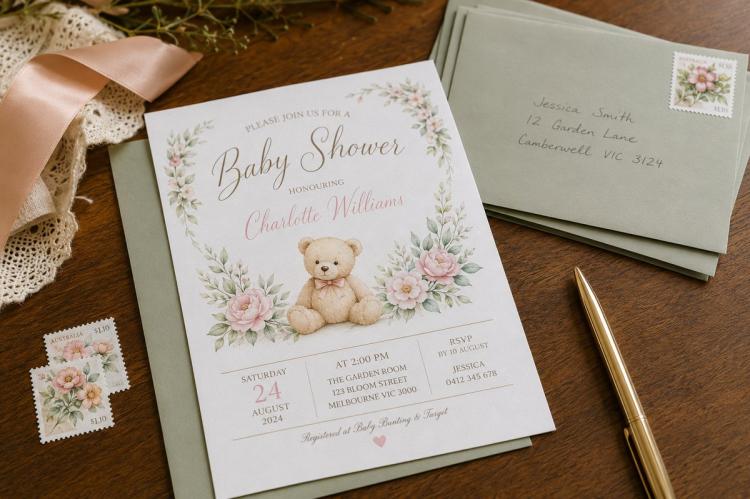
Printed or digital
Both are now normal, and the choice is practical rather than a matter of manners.
Printed invitations still suit a formal shower, and they suit guests who are less comfortable with online tools — often the older relatives most likely to feel slighted by a link. They take longer and cost more: allow a fortnight for design, printing and posting on top of the notice given to guests.
Digital invitations have become widely used and are frequently preferred, being cheaper, quicker and easier to track. Their real advantage is administrative. Replies arrive in one place, updates can be sent to everyone at once if a detail changes, and links to a gift list or a map can be embedded rather than printed. They suit casual showers, short notice and remote guests particularly well.
Messaging apps sit somewhere between the two, and in Britain a WhatsApp message is often the most practical option of all. Sent individually, it behaves like any other digital invitation and carries a designed card, a map and a link to a gift list perfectly well. The limitation is register: a message looks like a message, so a formal shower, or a guest list weighted towards older relatives, is better served by something that looks like an invitation.
A group chat is a different proposition. It works where the group already exists and is active, where the guests know one another, and where the shower is a casual one. Creating a group for the occasion fails all three tests. Replies also tend to scroll away unanswered, so a stated deadline and a request for a simple yes or no — or a thumbs up — matter more here than anywhere else. Two things do not belong in a group chat at all: the address of a surprise shower, which is then visible to everyone who might mention it, and gift list details, which read as considerably more presumptuous in a thread than behind a link.
A phone call remains the right approach for a shower arranged in a hurry, or for a surprise where a card arriving at the house would give the game away.
What every invitation needs
- The guest of honour's full name, or both parents' names for a joint shower
- The host's name, which is what signals who is giving the party rather than asking for gifts
- The date and the start time
- The full address, with parking or transport notes where the venue is awkward to reach
- How to reply and by when
- Whether children are included, and whether partners are
The last point saves a round of messages. Guests need it to arrange their afternoon, and the host needs the answer before confirming numbers.
Anything else — a theme, a dress code, a request for books instead of cards — sits comfortably on the invitation too, provided it stays brief.
Gift lists and registries
This is the part that causes hesitation, and the older etiquette was strict: gift information was given only when a guest asked. That rule has loosened considerably. Many guests now expect the details and find their absence unhelpful, since guessing produces duplicate presents and wasted money.
The tactful approaches are well established. Registry or gift list details can go on a small separate insert card rather than the main invitation, or on a link within a digital invitation, or on a simple event page mentioned in one line. Any of these keeps the invitation itself about the occasion rather than the presents.
Two things are worth adding. A short line making clear that gifts are welcome but not expected removes most of the awkwardness, and costs nothing. And where guests are being asked to contribute towards one large item rather than buy from a list, saying so plainly avoids confusion.
Conventions differ by country here. In the United States a registry is close to universal and its inclusion on the invitation is now common. In Britain gift lists are widely used but not assumed, and contributions towards a single expensive item are more usual than a long list — so a line explaining what is being done is more useful than a bare link.
Timing and replies
Invitations go out four to six weeks before the shower, and earlier where guests are travelling a distance or the date falls near a bank holiday. Two to three weeks is the practical minimum. Anything shorter and guests have no time to arrange the day or buy a present.
The reply deadline is best set about two weeks before the event. That leaves room to confirm catering numbers, finalise seating and chase the people who have not answered — and there will be some, on any guest list of any size. A week before the shower, the host contacts them directly. It is not an imposition; an accurate headcount determines the food, the seating and often the final bill.
Where the invitation is digital, replies collect themselves. Where it is printed, a nominated email address or mobile number works better than a phone number alone, since most guests will reply in whatever form is easiest for them.