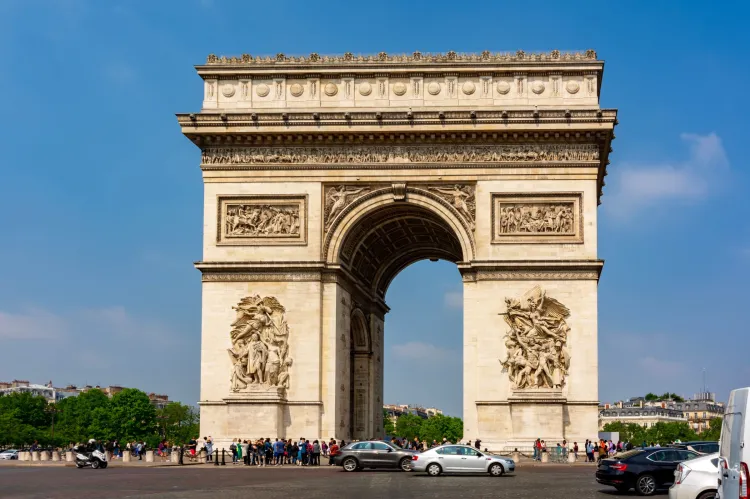
Getting up, and getting across
- Do not attempt the roundabout. Twelve avenues meet here, which is what gives the Place de l'Étoile its name, and the monument's operator states flatly that it cannot be reached on foot across the surface. The entrance is an underground passage, signed from the top of the Champs-Élysées and from the Avenue de la Grande Armée.
- The climb is 284 steps — two hundred and two to the museum level inside the attic, then eighty-two more to the terrace.
- The lift is not running. It has been out of service since late July 2026 and a renovation is planned, with a return date during 2027 still to be announced. Until then the stairs are the only access, which makes the monument effectively closed to anyone who cannot manage them. Visitors with reduced mobility can still be brought by vehicle to the Grande Armée side without booking.
- Admission to the terrace and museum is charged; the tomb is always free and needs no ticket.
- The free-entry rules are not what older accounts say. Under-eighteens of any nationality go free. The eighteen-to-twenty-five exemption applies to nationals of the European Union and the European Economic Area, and to non-Europeans legally resident in France — so a British twenty-two-year-old, who would have entered free before 2021, now pays. Free also for a disabled visitor and one companion, and on the first Sunday of January, February, March, November and December, plus both days of the Heritage Days weekend in September. Individuals need not book, though it is sensible; groups must book well ahead.
The size of it
Older accounts give the dimensions with the labels transposed. It is 49.5 metres high, 44.8 metres across the front and 22.2 metres deep — so the forty-five-metre figure is the width of the façade, not a length, and the twenty-two is the depth from front to back. The great vault is 29.4 metres; there is a second, smaller vault across it of about eighteen and a half, which is why "the vaulted passageway" needs a qualifier.
It was built between 1806 and 1836 and inaugurated on 29 July 1836 — thirty years, through four changes of regime. The architect was Jean-François-Thérèse Chalgrin, whom older accounts never name, and who died in 1811 with the thing barely out of the ground; it passed through two more architects before Guillaume Abel Blouet finished it.
Napoleon passed under it once, and he was dead
Older accounts say that Napoleon never had the chance to march through his own arch, Waterloo having ended his monument-building. The first half is nearly right and the second is worth replacing, because what actually happened is better.
When Napoleon married Marie-Louise of Austria in 1810, the arch was a stump. So a full-size mock-up was built in timber frames and painted canvas for the wedding procession to pass through, at a cost of half a million francs and employing five hundred workers. He rode through a stage set of his own monument.
And on 15 December 1840, when his remains were brought back from Saint Helena, the funeral cortège passed beneath the finished arch on its way to the Invalides. So he did go through it — nineteen years dead.
The tomb, and the flame
Older accounts date the Tomb of the Unknown Soldier loosely to the end of the First World War. The sequence is precise and worth having. The body was brought here on 11 November 1920 and lay under vigil; the burial was on 28 January 1921. The flame was first lit on 11 November 1923.
The part no older account mentions is that it is still being done by hand. The flame is rekindled every evening at half past six, by a federation of several hundred veterans' associations who have maintained the ceremony without a break for more than a century. It takes a few minutes, it happens whatever the weather, and almost nobody schedules a visit around it.
Around and inside the attic are engraved six hundred and sixty names, together with a hundred and fifty-eight battles and sieges. The convention older accounts describe is correct: an underlined name is a man killed in action.
Wrapped, and ransacked
Two things have happened to the monument since older accounts were written, and they pull in opposite directions.
In September and October 2021 the Arc was wrapped — twenty-five thousand square metres of silvery-blue fabric and three kilometres of red rope — in a work by Christo and Jeanne-Claude first conceived in 1961 and finally realised, for sixteen days, after both artists were dead. It is the most widely photographed thing the building has ever done.
And on 1 December 2018, during the gilets jaunes protests, the museum and shop inside were ransacked and the monument daubed inside and out; a plaster cast had its face partly destroyed. The damage ran close to a million euros and the Arc was closed for eleven days. Both episodes are now part of what the building is, and the second explains why the security at the entrance is heavier than the monument's size would suggest.
Why it can be seen from so far away
Older accounts credit Parisian rules forbidding tall buildings. The rules are real, though the causal claim is doing more work than it can bear, and they have moved twice since.
The low cap dates from the reaction against the Tour Montparnasse, finished in 1973 at over two hundred metres and widely regarded as a civic error. Limits were relaxed in 2010 to allow office towers of up to a hundred and eighty metres in outer districts, and then tightened again in 2023 to a thirty-seven-metre ceiling across the city, confirmed in the new planning scheme the following year.
The relaxation left one monument behind it. The Tour Triangle, a hundred and eighty metres, is under construction at the Porte de Versailles and due for completion in 2027; it will be the third-tallest structure in Paris after the Eiffel Tower and the Tour Montparnasse, and the argument about it is what produced the re-tightening. From the terrace here, it will be the new thing on the southern skyline.
From the top
The view is the reason to climb, and the thing to look for is the geometry rather than the landmarks: twelve avenues running out like spokes, the Champs-Élysées dropping east to the obelisk at the Concorde with the Louvre beyond it, and the Grande Arche at La Défense closing the same axis to the west. Paris is one of very few cities whose plan can actually be read from a single point, and this is the point.
The nickname the city goes by, incidentally, is the City of Light, singular — not lights. It is usually traced to the street lanterns installed under Louis XIV, when lighting a whole city at night was a novelty, and sometimes to the Enlightenment a century later.
Access is by the Métro to Charles de Gaulle–Étoile, on lines 1, 2 and 6, or the suburban line A.