Most conjunctivitis clears without treatment, which is why antibiotics are no longer routine. What the three kinds look like, what actually helps, and the red-eye warning signs that are not conjunctivitis at all.
What it is
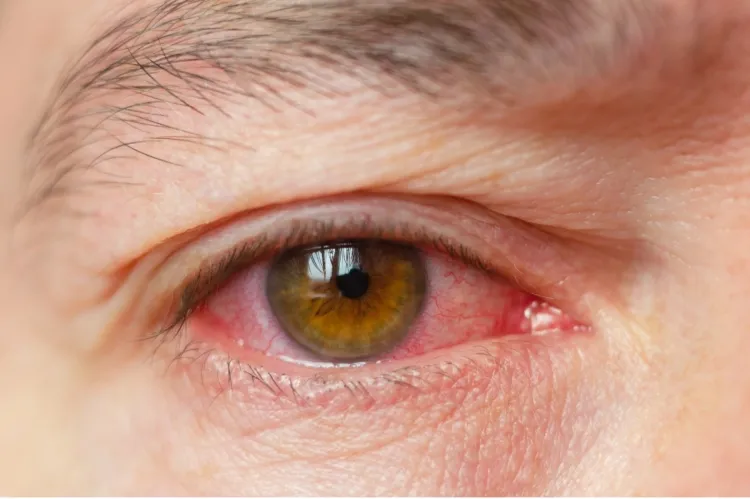
The conjunctiva is the thin transparent membrane covering the white of the eye and lining the inside of the eyelids. Conjunctivitis is inflammation of that membrane. The small blood vessels running through it dilate, which is what turns the white of the eye pink or red and gives the condition its common name.
It is among the commonest eye complaints, it is usually self-limiting, and in most cases it does not need a doctor. That said, a red eye is also how several more serious conditions begin, which is why the last part of this page matters more than the rest of it.
The three kinds
Viral conjunctivitis is the commonest. It typically begins in one eye and spreads to the other within a day or two. The discharge is watery, the eye feels burning or gritty rather than painful, and it often arrives alongside a cold or sore throat. It is highly contagious and usually takes one to two weeks to settle.
Bacterial conjunctivitis produces a thicker, stickier discharge, and the characteristic complaint is waking with the lids gummed together. It often affects both eyes. Mild cases usually clear within five to seven days without any treatment at all.
Allergic conjunctivitis affects both eyes at once and its dominant symptom is itching rather than grittiness. The lids often swell. It appears seasonally with pollen, or on contact with animals, dust or cosmetics, and it is not contagious. A version caused by cosmetics or chemical contact is sometimes separated out as irritant conjunctivitis.
Worth saying plainly: telling viral from bacterial by appearance alone is unreliable, even for clinicians. The discharge is a weak guide. That uncertainty is part of the reason for the next section.
Why it is usually left alone
This is where advice has changed most, and where older material is still giving the old answer.
Antibiotic drops used to be prescribed routinely for anything that looked infective. They are not recommended routinely now. Most acute infective conjunctivitis is self-limiting: mild bacterial cases typically resolve in five to seven days untreated, and non-herpetic viral cases in one to two weeks. Antibiotics do nothing whatever against a virus, and since the two cannot be reliably told apart by looking, routine treatment means treating a great many viral infections with an antibiotic that cannot help them.
Antibiotics are indicated in specific circumstances: severe infection, no sign of improvement after four or five days, newborn babies, and chlamydial infection. A delayed prescription, to be used only if things have not improved, is a common and sensible middle course.
Chloramphenicol drops can be bought over the counter for anyone aged two or over. That availability is convenient when they are genuinely needed, but it is not in itself a reason to use them by default — the same reasoning applies whether a prescription is involved or not.
What actually helps
The useful measures are unglamorous and mostly mechanical.
Crusting is cleaned away with cotton wool soaked in cooled boiled water or sterile saline, using a fresh piece for each eye. A cool compress held gently over the closed lid relieves the soreness. Lubricating drops — ordinary artificial tears — ease the gritty feeling and are worth more than most people expect.
For the infective kinds, the rest is about not spreading it: washing hands often, not sharing towels, flannels or pillows, washing bedding and face cloths, and resisting the urge to rub. Rubbing one eye and then touching the other is the usual route by which a one-eyed problem becomes a two-eyed one.
Allergic conjunctivitis is a different job
Treating allergy as though it were infection is a common mistake, and antibiotic drops do nothing for it.
The first steps are identifying and avoiding the trigger, not rubbing the eyes — rubbing causes the mast cells in the conjunctiva to release more of the histamine driving the symptoms, so it reliably makes things worse a few minutes after it makes them better — cool compresses, and lubricating drops to wash allergen off the surface of the eye. Taking contact lenses out for the duration helps.
Beyond that, two classes of drop are used. Mast cell stabilisers, of which sodium cromoglicate is the common one, can be bought without a prescription and work by preventing the release rather than blocking its effects, so they are most useful started before or early in a season. Dual-action drops combining an antihistamine with a mast cell stabiliser act faster and are taken less often. There is no good evidence favouring one topical preparation over another, so the choice is a conversation with a pharmacist rather than a matter of finding the right brand.
Where there are nasal symptoms too, an ordinary oral antihistamine treats both at once. The wider picture is covered under hay fever and mould allergy.
Two more severe forms are worth knowing by name, because they belong in ophthalmology rather than at a pharmacy counter. Vernal keratoconjunctivitis is a seasonal condition affecting mainly children; atopic keratoconjunctivitis is its chronic counterpart in adults. Both can involve the cornea rather than only the conjunctiva, and both can scar the eye if left untreated. The signal is persistence and severity — allergic eye symptoms in a child that do not settle on the usual treatment, or any allergic eye problem that comes with pain, light sensitivity or an effect on vision, needs assessing properly rather than another course of drops.
Contact lenses change the urgency
A red eye in someone who wears contact lenses is not treated as routine conjunctivitis until something more serious has been excluded.
Lenses come out straight away and stay out. The eye then needs to be looked at promptly — the same day — by an optometrist or an urgent eye service, because microbial keratitis, an infection of the cornea rather than the conjunctiva, presents with a red eye and can scar the cornea permanently. Severe cases in lens wearers are referred to ophthalmology specifically to rule out acanthamoeba, which is rare, extremely painful and difficult to treat. The habits that prevent it are covered under wearing contact lenses safely.
The distinction matters because the self-care advice above is correct for conjunctivitis and inadequate for keratitis, and from the outside they can look much the same.
Babies, and why twenty-eight days matters
Red eyes in a baby less than twenty-eight days old need urgent medical assessment rather than watchful waiting.
Conjunctivitis in the newborn period can be caused by organisms acquired during birth, including gonococcal and chlamydial infection, and these can damage the eye quickly. It is treated as a specialist matter and needs same-day attention.
This is different from the very common sticky eye in young babies caused by a blocked tear duct, where there is discharge but the eye itself is not inflamed. That usually resolves on its own. But the distinction is not one to make at home in a newborn, and the safe course is to have it looked at.
A red eye in any child under two is also worth a GP appointment rather than self-care.
School, nursery and work
Exclusion is not recommended.
UK health guidance does not advise keeping children away from school, nursery or childminders for conjunctivitis, and it is not normally necessary to stay off work either. The exception is an outbreak or cluster, where local advice may differ.
This often surprises people, given how contagious the viral form is. The reasoning is that exclusion does not meaningfully control spread for a condition that is mild, self-limiting and infectious before it is obvious — while the cost in missed schooling and work is real.
When a red eye is not conjunctivitis
This is the part worth reading even by someone confident they know what they have. A number of conditions that need prompt treatment begin as a red eye and can resemble conjunctivitis in the first day or two.
Go to an emergency department, or call 999, for a red eye with any of:
- any change in sight — wavy lines, flashing or loss of vision
- pain on looking at light
- a severe headache with feeling sick
- an eye that is very dark red
- an injury to the eye, or anything pierced or stuck in it
Seek urgent advice the same day for a red eye that is painful rather than merely sore, for any red eye in a contact lens wearer, and for red eyes in a baby under twenty-eight days old.
Several other things cause a red eye without being conjunctivitis at all, and most are harmless: a burst blood vessel on the white of the eye, dry eye, blepharitis, an ingrowing eyelash, or a lump or swelling on the lid.
The general rule is that conjunctivitis is uncomfortable, gritty and itchy. It is not properly painful, it does not affect vision beyond a blur that clears on blinking, and it does not make light hurt. Anything that does belongs in a different category and should not be waited out.
The conditions those warnings are for
These are the reason the list above exists. None of them is common, and none can be diagnosed at home — but knowing the names makes it possible to recognise a pattern and ask the right question, rather than assuming a red eye is always conjunctivitis.
One visible distinction runs through several of them. In conjunctivitis the redness is spread across the white of the eye and is often heaviest towards the outside and under the lids. In the more serious conditions it tends to concentrate in a ring immediately around the coloured part of the eye. That ring of redness, close in around the iris, is worth taking seriously.
Acute angle-closure glaucoma is a sudden, steep rise in pressure inside the eye. It brings severe pain in and around the eye, blurred vision, and rainbow-coloured haloes around lights. The nausea, vomiting and headache can be bad enough to dominate everything else and send people looking for a stomach explanation. The eye is red, the cornea may look hazy, and the pupil sits mid-sized and does not respond to light. It is a medical emergency, and sight depends on the pressure being brought down quickly.
Anterior uveitis, also called iritis, is inflammation inside the front chamber of the eye. The pain is deep and aching rather than gritty, and worsens on focusing at close range. Light hurts, sometimes even light shone into the other eye. The redness forms the ring around the iris described above, and the pupil may look small or irregular. It needs urgent ophthalmology assessment. It keeps company with several conditions elsewhere in the body, including ankylosing spondylitis, inflammatory bowel disease and sarcoidosis, so a history of any of those raises the odds.
Keratitis, and the corneal ulcer it can produce, is inflammation or infection of the clear window at the front of the eye. Pain, light sensitivity, blurred vision and a persistent sensation of something in the eye are the pattern. Bacterial keratitis is uncommon in the general population and concentrated among contact lens wearers, which is the whole reason a red eye in a lens wearer is treated differently. Everyone with suspected keratitis is seen by ophthalmology.
Scleritis is inflammation of the white coat of the eye itself. The pain is deep and boring, characteristically worse at night and on moving the eye, and the eye is tender to touch through the closed lid. The colour is a clue: a bluish or violet tinge rather than the pink of conjunctivitis. Between a third and a half of cases turn out to have an underlying rheumatological condition. It needs urgent referral, because severe untreated scleritis can thin and perforate the wall of the eye.
Episcleritis is the far milder relative of scleritis, affecting a more superficial layer. It usually produces a patch of redness with little or no pain and settles on its own. It is worth knowing about mainly so that the contrast with scleritis is clear: the distinguishing feature is pain, and scleritis hurts.
The common thread is simple enough to carry away. Pain, sensitivity to light, and any loss of vision are the three findings that point away from conjunctivitis and towards something that needs looking at the same day.
If self-care has not produced improvement within a few days, a sight test or an optometrist appointment is the straightforward next step — optometrists are equipped to examine the eye properly and will refer onwards if needed.
Changed