Why does time seem to speed up as you get older?
Inside Chester Cathedral there's a clock with a little verse beside it. It traces a whole life in four steps. When the writer was a baby, time crept. As a boy, it walked. As a man, it ran. And as he grew older, time flew.
You probably don't need it explained. Most adults feel it: summers that once lasted forever now vanish in a blink, and another year is over before you've got used to writing its date. But is time really speeding up? The answer turns out to be more interesting than the saying.
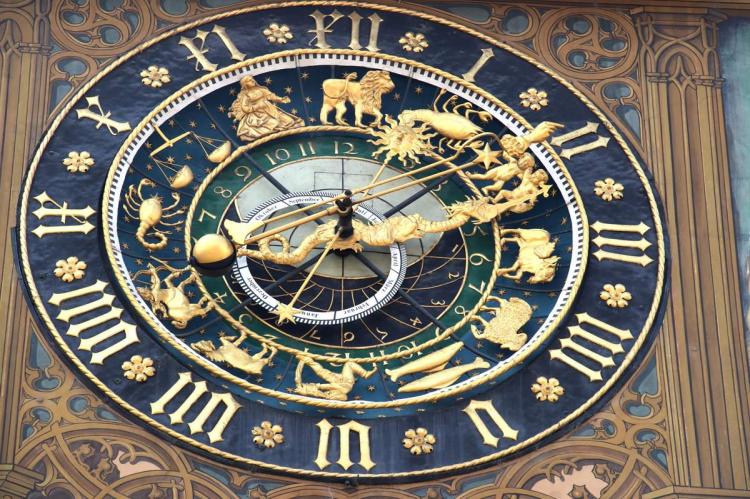
Clock time never changes. The time in your head is another matter.
The surprise: your days aren't getting faster
Psychologists have tested the feeling directly, by asking people of different ages how fast time seems to pass. The first large survey, in Germany and Austria in 2005, asked people aged 14 to 94 how quickly the last hour, week, month, year and decade had gone. The results were unexpected. For the hour, the week, the month and even the year, age made no real difference. People of every age said time was passing quickly.
Only one question showed a clear age effect: how fast did the last ten years go? Older people said the decade had flown by. Later studies in the Netherlands, New Zealand, Canada and Japan found the same pattern. One of them, with nearly two thousand Dutch volunteers aged 16 to 80, found that even for the decade the difference was fairly small.
It's not the days that speed up. It's the decades, seen in hindsight.
So the feeling is real, but it lives somewhere specific. It isn't in the moment. It's in memory.
Two clocks in your head
To see why, it helps to know that your brain keeps track of time in two different ways.
The first is prospective time: how long something feels while it's happening. Waiting for a kettle to boil, or sitting in a dull meeting, stretches prospective time. The second is retrospective time: how long a stretch of time seems when you look back on it afterwards. And here's the key point. When you look back, your brain doesn't consult a clock. It goes through your memories. Lots of distinct, new memories make a period feel long. Few memories make it feel short.
That leads to a strange effect that the psychologist and broadcaster Claudia Hammond calls the holiday paradox.
| While it's happening | Looking back afterwards | |
|---|---|---|
| A week on holiday | Flies by, because every day is full and new | Feels long, because it's packed with fresh memories |
| A routine week at work | Can drag, hour by hour | Shrinks to almost nothing, because each day looks like the last |
Now apply that to a whole life. Youth is a long holiday of firsts: first school, first friends, first job, first time living away from home. Each one leaves a vivid mark. Later life is full of repeats: the same commute, the same shops, the same routines. Repeats are efficient, but they leave very little behind in memory. So when you look back over the last ten years, there isn't much there to measure, and the decade seems to have passed in a flash.
[Image: a simple editorial graphic showing two timelines, one dotted thickly with memory markers (youth) and one with only a few (a routine decade). Caption: "Your brain measures the past by what it remembers. Fewer new memories make the years look shorter."]
An older idea, and why it isn't enough
There's another explanation you may have heard. In 1877 the French philosopher Paul Janet suggested that each stretch of time feels shorter because it's a smaller slice of the life you've lived so far. To a five-year-old, one year is a fifth of their whole existence. To a fifty-year-old, it's a fiftieth.
It's a neat idea, and it's easy to remember. But it's more of an elegant guess than a proven law. It also can't explain the most striking finding: that the speeding-up only shows clearly when people think about long stretches like a decade, and hardly at all for a week or a month.
How we know: what the newest research says
Recent studies point back to memory. A study published in 2026 found that people who felt the last decade had raced by were not simply those with fewer personal memories stored up. What mattered was how well they could lay down new memories. In other words, the brain's ability to record fresh experiences seems to be part of what keeps the years feeling full.
Busyness matters too. In one large study, how rushed people felt explained about a tenth of the differences in how fast time seemed to go. Women, who on average reported feeling more rushed than men, also felt time went faster. Time pressure and the feeling of speed seem to go hand in hand at any age.
Scientists aren't completely sure yet how all the pieces fit. One more unusual idea, from the engineer Adrian Bejan, suggests that an ageing brain simply takes in fresh images of the world more slowly, so fewer of them arrive in each hour. It's an intriguing proposal, but it hasn't been widely tested, and other researchers have questioned parts of it. The best current evidence points to a mix of memory, novelty and busyness rather than a single cause.
So what?
Here's the hopeful part. If routine makes the years shrink in hindsight, then new experiences stretch them back out. You don't need a grand adventure to do it. A different walk to work, a new recipe, a class in something you've never tried, a day trip to a town you've never seen: each one gives your memory something fresh to hold on to.
You can't slow down the clock on the wall. But you can change what the clock in your head has to work with.
In short
Time doesn't really pass faster as you get older, at least not in the moment. What changes is how long the years seem when you look back, because your brain measures the past by the new memories it made. Routine leaves few, so the decades seem to fly. Fill your days with new things, and they'll feel longer when you look back.
References
- Friedman, W. J., & Janssen, S. M. J. (2010). Aging and the speed of time. Acta Psychologica, 134, 130–141.
- Hammond, C. (2012). Time Warped: Unlocking the Mysteries of Time Perception. Canongate.
- Janet, P. (1877). Une illusion d'optique interne. Revue Philosophique de la France et de l'Étranger, 3, 497–502. English translation in Timing & Time Perception, 10(3), 279–287 (2022).
- Janssen, S. M. J., Naka, M., & Friedman, W. J. (2013). Why does life appear to speed up as people get older? Time & Society, 22(2), 274–290.
- Teghil, A., Wittmann, S., Lifrieri, A., Saad, S., Boccia, M., & Wittmann, M. (2026). Memory encoding for new information, not autobiographical memory load, is linked with age-related differences in subjective time passage over the past decade. Memory & Cognition.
- Wittmann, M., & Lehnhoff, S. (2005). Age effects in perception of time. Psychological Reports, 97, 921–935.
- Bejan, A. (2019). Why the days seem shorter as we get older. European Review, 27(2), 187–194.