Mahjong sets: tiles, racks and tables
A mahjong set is the rare game purchase that lasts decades, which is why it attracts more deliberation than most. It is also a purchase that has become harder to research rather than easier. The boutique end of the market has grown quickly and is overwhelmingly American, so a great deal of what comes up when searching describes sets built for American rules, priced in dollars and photographed as furnishings.
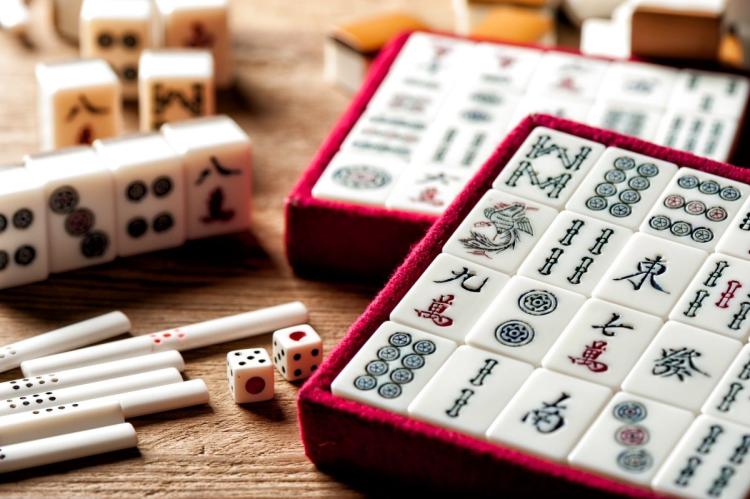
That matters, because the first question is not material or colour. It is which game the set is for.
The count depends on the variant
Sets are not interchangeable. The four widely played variants need different tiles, and a set bought for one can be unusable for another.
| Tiles | Includes | Also needed | |
|---|---|---|---|
| Hong Kong and British | 144 | Flowers and seasons | Dice, wind indicator |
| Japanese riichi | 136 | No flowers; often red fives | Point sticks, dealer marker |
| American | 152 | 144 standard plus eight jokers | Racks and pushers, the current year's card |
Two points of confusion are worth clearing up. An "American set" describes the rules it suits, not where it was made — almost all sets are manufactured in Asia regardless of the market they serve. And most sets ship with spare tiles beyond the playing count, since a lost tile from a matched set is otherwise a serious problem, so a tile count higher than the table above is normal rather than wrong.
A 144-tile set will cover Hong Kong and British play, which is what most clubs and community groups in Britain use. It will also serve for riichi at a pinch, by setting the flowers and seasons aside, though it will lack point sticks and red fives. It cannot be used for American play, because the jokers are not there.
Tile materials
Modern tiles are almost always one of two plastics, and the choice between them is more about feel than quality.
Melamine is the standard for everyday sets. It is hard, scratch-resistant and produces the deeper, more resonant sound that many long-standing players consider part of the game.
Acrylic dominates the designer end. It takes colour and deep engraving well, which is why the decorative sets of the past few years are mostly acrylic. It is slightly softer than melamine, though the depth of the engraving means designs survive surface wear.
Resin and composite sets sit alongside these, lighter and often the most decorative, made for display as much as play.
Two older materials turn up second-hand. Bakelite sets, mostly from the 1930s and 1940s, are collectible, weighty and prone to yellowing with age. Bone and bamboo sets — tiles of bone dovetailed onto bamboo backs — are the traditional construction and the one most likely to be inherited rather than bought. Both are perfectly playable; both dislike heat and humidity considerably more than modern plastics do.
Size, weight and legibility
This is the specification that gets the least attention and makes the most difference in use.
Tiles vary widely, with common sizes running from roughly 25 to 35 millimetres across the face. Larger tiles are easier to read across a table and easier to handle for anyone with arthritis or reduced dexterity; smaller travel sets are easier to shuffle and pack but harder to read by lamplight. Weight follows a similar trade-off — substantial tiles feel better in the hand and can tire it over a long session.
Anyone buying for a group that includes beginners should look at the faces rather than the finish. High-contrast engraving is far easier to learn from than subtle tonal designs, and sets that carry Arabic numerals alongside the Chinese characters shorten the learning curve considerably. Most players stop needing the numerals within a few sessions, but the first few sessions are the ones where people decide whether they enjoy the game.
Racks, pushers and the rest
How much equipment a set needs depends entirely on the variant.
Racks and pushers are essential for American play, where tiles are held on a rack in front of each player rather than in the hand, and the pusher slides the built wall into the centre. They are optional elsewhere, though some players with limited hand mobility use them regardless.
Point sticks are standard in riichi, which tracks a running points total through the game rather than settling hand by hand.
Dice appear in every variant, used to determine the dealer and where the wall is broken. Wind indicators are common in British and Hong Kong play.
A mat or cloth is the accessory worth having whatever the variant. It quietens the shuffle, protects the table, stops tiles sliding into one another and defines each player's space. Mats should be rolled rather than folded, since a crease across a playing surface is permanent and irritating.
A case is not decoration. Tiles stored loose get chipped and lost, and a matched set missing one tile is close to worthless.
Tables
An ordinary dining table is entirely adequate, and most home play happens on one. What matters is that four people can sit comfortably with elbow room, and that the surface is not bare glass or polished wood, which turns the shuffle into something the neighbours can hear. A mat solves this cheaply. A folding card table is the usual answer for groups running two tables at once.
At the other extreme are automatic mahjong tables, which shuffle the tiles and build the wall mechanically, and are standard equipment in parlours across East Asia. They remove several minutes of handling from every hand and are genuinely transformative for a group that plays weekly. They are also heavy, expensive and difficult to move, which puts them firmly in the category of equipment for an established group rather than a first purchase. They are available in Europe, though the market is small and shipping costs are a real consideration.
Inherited sets, and the rules on ivory
A great many British households contain a 1920s mahjong set, a legacy of the craze that swept Britain and America in that decade. These are usually bone and bamboo, and are frequently assumed to be ivory when they are not — the two look similar to an untrained eye, and the distinction genuinely matters.
Where a set is ivory, the Ivory Act 2018 applies. The Act has been in force since June 2022 and bans dealing in items made of or containing ivory unless the item is registered under a specific exemption, with the ban extended in January 2025 to cover hippopotamus, killer whale, narwhal and sperm whale ivory as well as elephant. Dealing covers buying, selling, hiring and offering to do any of those, and the penalties are severe — a maximum fine of £250,000 or up to five years' imprisonment.
The practical consequence for mahjong is straightforward. The exemption most often cited for antiques applies to items made before March 1947 containing less than ten per cent ivory by volume, which a set of ivory tiles will not meet. A genuinely ivory set is therefore very unlikely to be saleable in the UK.
None of this restricts owning or playing with an inherited set, which remains entirely lawful. It affects what can be done with it commercially. Anyone uncertain whether a set is bone or ivory should get an expert opinion rather than guess — specialists identify elephant ivory by the fine intersecting lines visible in cross-section, which bone does not have — and check the current government guidance before selling, since this is a summary rather than legal advice and the rules have already been extended once. Elsewhere in Europe, ivory is governed by CITES and national implementations that differ between member states, so the position is not uniform across the continent.
Buying in Britain and Europe
The decorative sets that dominate social media are largely American, made for American rules, and arrive with import costs attached. For anyone intending to play British or Hong Kong rules, they are also the wrong equipment, jokers included and flowers used differently.
A conventional 144-tile set, bought from a games retailer rather than a lifestyle brand, is cheaper, more useful and better suited to the versions played at UK clubs. Buying second-hand is sensible — mahjong sets outlive their owners — with the obvious checks: count the tiles, confirm the backs all match, and establish whether the spares are present.
The best approach of all is to play before buying. Most clubs and board game cafés running mahjong sessions have sets available, which allows several to be handled across a few evenings. Tile size, weight and sound are not qualities that translate through a photograph, and they are the qualities that determine whether a set gets used or shelved.