Deciding When to Have the Baby Shower, Before or After
Most baby showers are held in the last months of pregnancy, but holding one after the birth has genuine advantages. The date has to be settled first, because nothing else can be booked until it is.
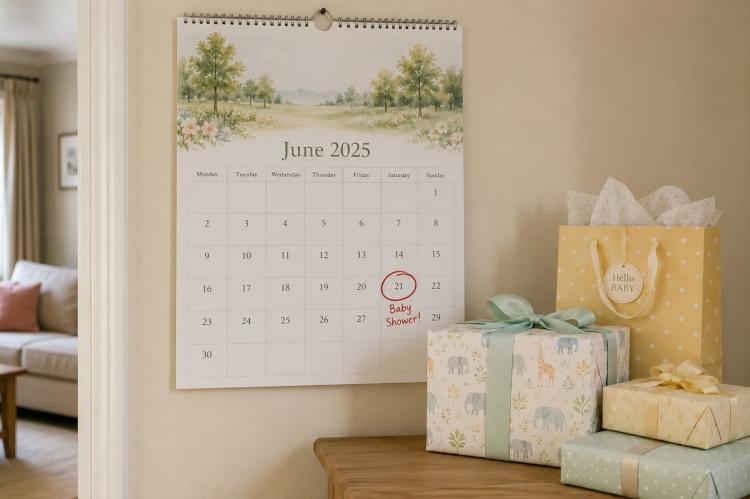
The timing decision comes before every other decision. Venues, invitations, catering and time off all depend on it, so it is worth settling early even where the rest of the planning is still vague.
The case for holding it before the birth
The practical argument is the strongest one. A first baby arrives into a household that owns almost nothing it needs, and most of that is needed immediately. A shower six or eight weeks ahead leaves time to see what was given, work out what is still missing and buy the rest without hurry.
There is also the question of who the occasion is for. Before the birth, the expectant parents are the guests of honour and the attention stays with them. Once the baby arrives, the baby becomes the centre of any gathering — which is lovely, but it is a different event.
Gift-buying is not the obstacle it once was. The sex of the baby is commonly known from the twenty-week scan, and many parents have settled on a nursery scheme well before the shower, so guests can buy specifically if they want to.
The usual window is the third trimester, roughly between twenty-eight and thirty-six weeks. Earlier tends to feel premature; later risks the baby arriving first. Maternity leave offers a natural anchor, since it can begin as early as eleven weeks before the due date, and a shower in the days around the last working day catches colleagues who want to mark the occasion.
The case for holding it after
A shower after the birth removes the uncertainty. The baby has arrived, the name and the details are known, and gifts that need engraving or personalising can be ordered without guesswork.
It also suits families who prefer not to celebrate in advance. Some traditions hold back gifts until the birth, and some parents simply find it easier not to mark a pregnancy before it has ended safely. Both are reasons enough, and neither needs explaining to guests.
For a second or third baby, an afterwards shower often makes more sense in any case. The cot and the pram already exist, and gifts can go towards the things that run out — nappies, clothes in the next size, and similar.
A post-birth shower does need to be a shorter and quieter affair than one held earlier. Four to six weeks is a common minimum, giving the parents time to settle before a room full of visitors arrives. Holding it at their home rather than a hired venue removes the travelling. Guests with coughs and colds are usually asked to come another time.
Settling it
Neither option is the correct one; they suit different circumstances. What matters is that the expectant parents choose, that the choice is made early, and that the format then matches it — a full afternoon with games and catering works before the birth, while a shorter, smaller gathering works better after.
Where a shower is held before the birth, it is worth having a loose plan for what happens if the baby arrives ahead of schedule. Deposits, cancellation terms and a possible alternative date are easier to think about in advance than in the week itself.