Baby Shower Favours
A favour is a small thank-you handed to guests as they leave. It is a pleasant custom rather than an obligation, and the ones that work are the ones people actually use.
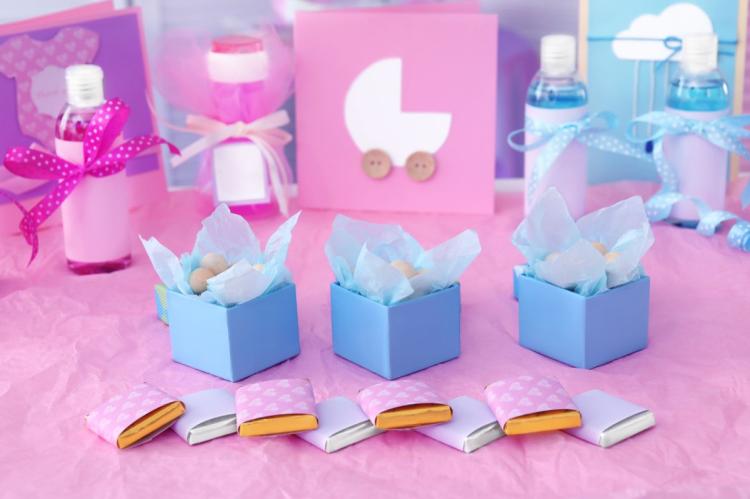
Are favours necessary?
Not universally. Favours are close to standard at American showers, where guests expect to leave with something. At British showers they are common but genuinely optional, and plenty of hosts skip them without anyone noticing.
That is worth stating plainly, because favours are usually the first thing a tight budget should drop. Guests come for the occasion and the company. Nobody has ever gone home disappointed by the absence of a small tin of sweets, whereas a host who spent the catering money on trinkets will notice.
Where they are included, the point is a small gesture of thanks — a note that the afternoon was appreciated and that coming mattered.
What works
The favours that succeed are consumable or useful. Anything else tends to be carried home politely and thrown away within the week, which is a poor return on both the money and the effort.
Consumable options include chocolates, sweets, biscuits, small jars of honey or jam, tea bags, and miniature bottles of something. Useful ones include candles, soap, seed packets, bulbs, and small plants — the last two being the rare favour that outlives the party by years.
Presentation carries more of the effect than the contents. A modest item in a good paper bag with a ribbon and a printed tag reads as considered; the same item loose in a bowl does not.
Where the shower has a theme, the favour is the easiest place to reflect it, and the traditional choices still work well — small yellow ducks, biscuits cut into baby shapes, candles shaped like bottles in pale pink and blue.
For a formal shower there is an equivalent range at a higher price: demitasse spoons tied with ribbon, silver-plated coffee scoops, chocolate truffles, or a candle set inside a china bootee.
Two things to avoid. Small plastic novelties are the classic favour and the classic piece of landfill, and a growing number of guests notice. And anything that assumes something about a guest's own life — a favour framed around motherhood, for instance — is best skipped, since the guest list will include people for whom that does not apply and may not be a comfortable subject.
Cost and numbers
Favours are a per-head cost, so they scale directly with the guest list. At a pound or two each the total stays modest; at four or five pounds each, thirty guests turn favours into a significant line in the budget. American prices run to a similar shape in dollars.
One per guest is the usual basis. Couples attending together are normally counted as two, though for anything substantial one per household is reasonable and unremarkable. A handful of spares covers the guests who arrive unannounced.
Favours are not prizes. Favours go to everyone; prizes go to whoever wins a game, and buying one set for both purposes leaves the winners with nothing to distinguish them.
When to order
Four to six weeks before the shower is the right window. By then the replies have mostly arrived and the numbers are stable enough to buy against, and there is still time for anything that has to be made or ordered specially.
Three weeks is the practical minimum for personalised favours, since printing, engraving and delivery all take longer than expected. Where nothing particular is wanted, favours can be bought at the last minute without difficulty.
Making them
Homemade favours are consistently better received than bought ones, and cheaper. Baking, jam, bath salts, seed packets and simple sewn or printed items all work.
The constraint is time, and the host generally has none to spare in the final fortnight. This is a job worth handing to a guest who has offered to help and has the relevant skill — it is self-contained, it can be done in advance, and it removes a whole line from the host's list.